08 Who Protects Human Rights?
/08 Who Protects Human Rights?
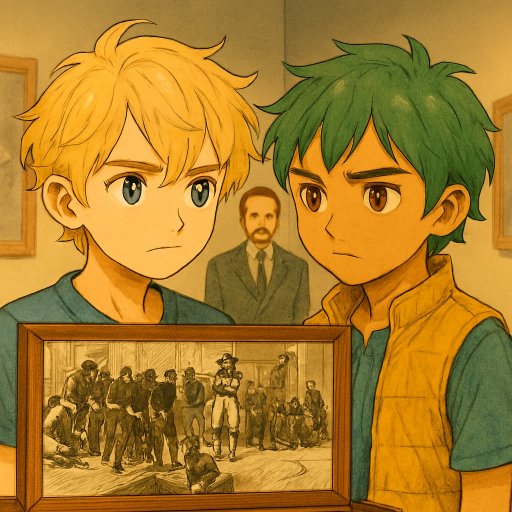
*Max visited a history museum with his best friend *David during summer vacation.
/*Max visited a history museum with his best friend *David during summer vacation.
It was a place to learn about the lives of people in the past and how society worked, especially known for its exhibit on “the history of human rights.”
/It was a place to learn about the lives of people in the past and how society worked, especially known for its exhibit on “the history of human rights.”
Inside the museum, they were guided by a staff member into a special exhibition room.
/Inside the museum, they were guided by a staff member into a special exhibition room.
There was a large model of a ship, packed tightly with many small human figures.
/There was a large model of a ship, packed tightly with many small human figures.
“This is a model of the ships that carried slaves taken from Africa. They were treated not as people, but as objects.”
/“This is a model of the ships that carried slaves taken from Africa. They were treated not as people, but as objects.”
*Max’s eyes widened.
/*Max’s eyes widened.
“Hundreds of people in such a tiny space…?”
/“Hundreds of people in such a tiny space…?”
*David was also speechless.
/*David was also speechless.
The exhibit explained the harsh lives slaves were forced to live.
/The exhibit explained the harsh lives slaves were forced to live.
They were stripped of freedom, separated from family, forced to work, and punished. Their dignity as human beings was not respected at all.
/They were stripped of freedom, separated from family, forced to work, and punished. Their dignity as human beings was not respected at all.
“Why was something like this allowed?”
/“Why was something like this allowed?”
*Max asked the guide.
/*Max asked the guide.
“At the time, people believed that race and social status determined a person’s value. But that was wrong. Today, the world recognizes that all people equally have human rights.”
/“At the time, people believed that race and social status determined a person’s value. But that was wrong. Today, the world recognizes that all people equally have human rights.”
*Max read the words at the end of the exhibit.
/*Max read the words at the end of the exhibit.
“Human rights belong to everyone. Protecting them is the responsibility of society as a whole.”
/“Human rights belong to everyone. Protecting them is the responsibility of society as a whole.”
Those words stayed deeply in *Max’s heart.
/Those words stayed deeply in *Max’s heart.
On the way home, *Max said to *David:
/On the way home, *Max said to *David:
“I thought human rights were protected by laws or governments. But now I see—they’re something each of us must protect.”
/“I thought human rights were protected by laws or governments. But now I see—they’re something each of us must protect.”
*David nodded.
/*David nodded.
“Yeah. I think not ignoring someone in trouble is also a way to protect human rights.”
/“Yeah. I think not ignoring someone in trouble is also a way to protect human rights.”
That week, during moral education class, there was a discussion about human rights.
/That week, during moral education class, there was a discussion about human rights.
*Max shared his experience at the museum.
/*Max shared his experience at the museum.
“People in the past treated others like objects. But now, I think we must build a society where everyone is valued.”
/“People in the past treated others like objects. But now, I think we must build a society where everyone is valued.”
The teacher smiled and said:
/The teacher smiled and said:
“Exactly. Human rights aren’t something someone else protects for us. They’re something we all protect together.”
/“Exactly. Human rights aren’t something someone else protects for us. They’re something we all protect together.”
*Max thought to himself:
/*Max thought to himself:
“I want to be someone who protects human rights.”
/“I want to be someone who protects human rights.”
And *Max began to take small actions—speaking to people in trouble, stopping discrimination or bullying, and listening carefully to others.
/And *Max began to take small actions—speaking to people in trouble, stopping discrimination or bullying, and listening carefully to others.
Review Questions (Multiple Choice)
/Review Questions (Multiple Choice)
① What did the ship model that *Max saw at the museum represent?
/① What did the ship model that *Max saw at the museum represent?
A. Life on a pirate ship
/A. Life on a pirate ship
B. Transportation of African slaves
/B. Transportation of African slaves
C. Journey of immigrants
/C. Journey of immigrants
② What did *Max learn about “protecting human rights”?
/② What did *Max learn about “protecting human rights”?
A. Something only countries and laws protect
/A. Something only countries and laws protect
B. Something unrelated to oneself
/B. Something unrelated to oneself
C. Something society as a whole should protect
/C. Something society as a whole should protect
Let’s Think!
/Let’s Think!
① Have you ever seen a situation where human rights weren’t being protected around you? What could you do in that moment?
/① Have you ever seen a situation where human rights weren’t being protected around you? What could you do in that moment?
② What do you think “human rights are something we all protect” means? What can your school or community do to support that idea?
/② What do you think “human rights are something we all protect” means? What can your school or community do to support that idea?