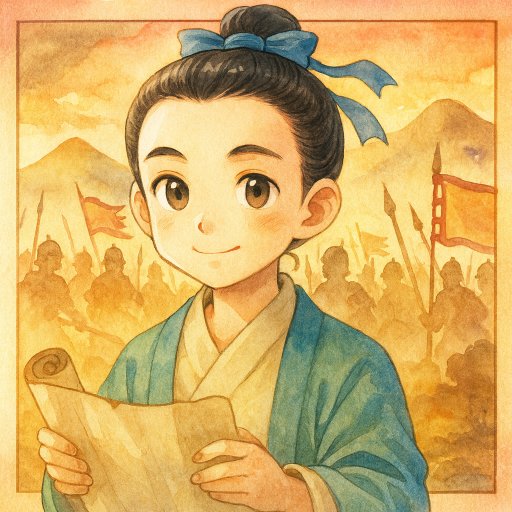
✍Learn from Sun Tzu(孫子・孙子)
/ ✍Learn from Sun Tzu(孫子・孙子)
① Who Was Sun Tzu❓
/ ① Who Was Sun Tzu❓
Sun Tzu was an ancient Chinese military thinker, traditionally believed to have lived during the Spring and Autumn period.
/ Sun Tzu was an ancient Chinese military thinker, traditionally believed to have lived during the Spring and Autumn period.
He is best known as the author of “The Art of War,” a short book of 13 chapters about strategy, leadership, and wise decision-making.
/ He is best known as the author of “The Art of War,” a short book of 13 chapters about strategy, leadership, and wise decision-making.
Although his work focuses on warfare, its ideas apply to everyday life—planning carefully, understanding others, and choosing calm over chaos.
/ Although his work focuses on warfare, its ideas apply to everyday life—planning carefully, understanding others, and choosing calm over chaos.
Sun Tzu taught that the best victory is the one won without fighting, through knowledge, timing, and preparation.
/ Sun Tzu taught that the best victory is the one won without fighting, through knowledge, timing, and preparation.
His lessons have influenced leaders, athletes, and students around the world for centuries.
/ His lessons have influenced leaders, athletes, and students around the world for centuries.
Today, people still read his work for guidance on teamwork, problem-solving, and self-control.
/ Today, people still read his work for guidance on teamwork, problem-solving, and self-control.
② The Story of Sun Tzu📖
/ ② The Story of Sun Tzu📖
The night air was cool in the valley, and lanterns glowed like patient stars along the river.
/ The night air was cool in the valley, and lanterns glowed like patient stars along the river.
A young officer stood by the water, clutching a bamboo scroll to his chest.
/ A young officer stood by the water, clutching a bamboo scroll to his chest.
On it were words that carried a quiet fire.
/ On it were words that carried a quiet fire.
They were the words of Sun Tzu.
/ They were the words of Sun Tzu.
He whispered them to steady his heart.
/ He whispered them to steady his heart.
“Know yourself.
/ “Know yourself.
Know your opponent.
/ Know your opponent.
A hundred battles, a hundred victories.”
/ A hundred battles, a hundred victories.”
But then he closed his eyes and added a thought of his own.
/ But then he closed his eyes and added a thought of his own.
“The wise victory is peace.”
/ “The wise victory is peace.”
Sun Tzu had not always been known for wisdom.
/ Sun Tzu had not always been known for wisdom.
As a youth, he had been quick to speak and quicker to act.
/ As a youth, he had been quick to speak and quicker to act.
He once tried to solve a quarrel with a raised voice and a raised fist.
/ He once tried to solve a quarrel with a raised voice and a raised fist.
It only made the quarrel grow.
/ It only made the quarrel grow.
That day, an old scholar placed a hand on Sun Tzu’s shoulder.
/ That day, an old scholar placed a hand on Sun Tzu’s shoulder.
“Strength without clarity is a storm,” the scholar said.
/ “Strength without clarity is a storm,” the scholar said.
“Clarity without compassion is a winter with no spring.”
/ “Clarity without compassion is a winter with no spring.”
Those words followed Sun Tzu like a shadow and a guide.
/ Those words followed Sun Tzu like a shadow and a guide.
He began to study not just the art of war, but the art of understanding.
/ He began to study not just the art of war, but the art of understanding.
He watched the seasons carefully.
/ He watched the seasons carefully.
In spring, the earth pushed green through mud.
/ In spring, the earth pushed green through mud.
In summer, rivers swelled with rain.
/ In summer, rivers swelled with rain.
In autumn, winds sharpened, and leaves learned to let go.
/ In autumn, winds sharpened, and leaves learned to let go.
In winter, the land rested and gathered quiet strength.
/ In winter, the land rested and gathered quiet strength.
From nature, he learned timing.
/ From nature, he learned timing.
From farmers, he learned patience.
/ From farmers, he learned patience.
From craftsmen, he learned precision.
/ From craftsmen, he learned precision.
He wrote on his bamboo strips, “Speed is nothing without timing, and timing is nothing without preparation.”
/ He wrote on his bamboo strips, “Speed is nothing without timing, and timing is nothing without preparation.”
He walked the markets and listened to merchants.
/ He walked the markets and listened to merchants.
He watched children play games and noticed how a simple feint could open a path to a gentle victory.
/ He watched children play games and noticed how a simple feint could open a path to a gentle victory.
He began to see that conflict was not only spears and shields.
/ He began to see that conflict was not only spears and shields.
Conflict lived in words, in choices, in pride, and in fear.
/ Conflict lived in words, in choices, in pride, and in fear.
One evening, a commander sent for him.
/ One evening, a commander sent for him.
“Our borders tremble,” the commander said.
/ “Our borders tremble,” the commander said.
“Enemies gather like thunderheads.
/ “Enemies gather like thunderheads.
I have soldiers.
/ I have soldiers.
I have iron.
/ I have iron.
What I do not have is wisdom.”
/ What I do not have is wisdom.”
Sun Tzu bowed.
/ Sun Tzu bowed.
“Steel gives strength to the arm,” he replied.
/ “Steel gives strength to the arm,” he replied.
“Wisdom gives direction to the hand.
/ “Wisdom gives direction to the hand.
Let us train both.”
/ Let us train both.”
He visited the camp, where soldiers shouted and clattered like pots in a storm.
/ He visited the camp, where soldiers shouted and clattered like pots in a storm.
He did not shout back.
/ He did not shout back.
He arranged drills that looked simple but required attention, patience, and trust.
/ He arranged drills that looked simple but required attention, patience, and trust.
He taught them to move as one.
/ He taught them to move as one.
He taught them to think as one.
/ He taught them to think as one.
He taught the captains to be calm in confusion and precise in calm.
/ He taught the captains to be calm in confusion and precise in calm.
“Order arises from clarity,” he wrote.
/ “Order arises from clarity,” he wrote.
“And clarity arises from listening.”
/ “And clarity arises from listening.”
There was a rumor that Sun Tzu once demonstrated discipline by drilling a group of palace attendants, who had never trained before.
/ There was a rumor that Sun Tzu once demonstrated discipline by drilling a group of palace attendants, who had never trained before.
They laughed at the idea that rhythm and rules could shape chaos.
/ They laughed at the idea that rhythm and rules could shape chaos.
Sun Tzu spoke softly, and the laughter softened.
/ Sun Tzu spoke softly, and the laughter softened.
He set clear commands.
/ He set clear commands.
He repeated them.
/ He repeated them.
He enforced them fairly.
/ He enforced them fairly.
The attendants began to move with surprising grace.
/ The attendants began to move with surprising grace.
Watching them, Sun Tzu smiled and thought, “Discipline is respect woven into action.”
/ Watching them, Sun Tzu smiled and thought, “Discipline is respect woven into action.”
When the time of danger drew closer, some officers argued for immediate attack.
/ When the time of danger drew closer, some officers argued for immediate attack.
“Strike now,” they urged.
/ “Strike now,” they urged.
“Strike hard.”
/ “Strike hard.”
Sun Tzu studied the maps.
/ Sun Tzu studied the maps.
He rode the ridges.
/ He rode the ridges.
He listened to the wind across the tall grass.
/ He listened to the wind across the tall grass.
He observed the enemy campfires and how they flickered early on cold nights and later on warm ones.
/ He observed the enemy campfires and how they flickered early on cold nights and later on warm ones.
He spoke quietly to the commander.
/ He spoke quietly to the commander.
“The enemy is strong when we are careless, and weak when we are careful,” he said.
/ “The enemy is strong when we are careless, and weak when we are careful,” he said.
“If we can win without a battle, we must choose that path first.”
/ “If we can win without a battle, we must choose that path first.”
The commander frowned.
/ The commander frowned.
“Without battle?
/ “Without battle?
How?”
/ How?”
Sun Tzu pointed to the river bend on the map.
/ Sun Tzu pointed to the river bend on the map.
“Here the supplies arrive.
/ “Here the supplies arrive.
If we guide the path rather than break the stone, the river of this conflict will change course.”
/ If we guide the path rather than break the stone, the river of this conflict will change course.”
He suggested careful negotiations, subtle movements, and visible strength that did not become violence.
/ He suggested careful negotiations, subtle movements, and visible strength that did not become violence.
He moved scouts like brushstrokes, wide and light.
/ He moved scouts like brushstrokes, wide and light.
He opened a corridor for farmers to pass safely.
/ He opened a corridor for farmers to pass safely.
He sent messages that were firm, fair, and precise.
/ He sent messages that were firm, fair, and precise.
He made it easy for the enemy to choose peace, and difficult for them to choose war.
/ He made it easy for the enemy to choose peace, and difficult for them to choose war.
Days passed with tension like a bowstring.
/ Days passed with tension like a bowstring.
Then, like a held breath finally released, the enemy withdrew.
/ Then, like a held breath finally released, the enemy withdrew.
Not because they were forced, but because continuing the fight became a poor choice.
/ Not because they were forced, but because continuing the fight became a poor choice.
The soldiers in Sun Tzu’s camp cheered.
/ The soldiers in Sun Tzu’s camp cheered.
The commander looked at Sun Tzu in wonder.
/ The commander looked at Sun Tzu in wonder.
“Is this victory?” he asked.
/ “Is this victory?” he asked.
Sun Tzu nodded.
/ Sun Tzu nodded.
“The best victory,” he said, “is the one that leaves the fewest wounds.”
/ “The best victory,” he said, “is the one that leaves the fewest wounds.”
Yet Sun Tzu did not celebrate loudly.
/ Yet Sun Tzu did not celebrate loudly.
He walked alone by the river.
/ He walked alone by the river.
He thought of the mothers who would not mourn, the fields that would not burn, the bridges that would not fall.
/ He thought of the mothers who would not mourn, the fields that would not burn, the bridges that would not fall.
He felt relief, and he felt responsibility.
/ He felt relief, and he felt responsibility.
He wrote, “When the battle you win is the battle you do not fight, remember to be grateful, not proud.”
/ He wrote, “When the battle you win is the battle you do not fight, remember to be grateful, not proud.”
He returned to the camp and listened to his soldiers laugh and sing.
/ He returned to the camp and listened to his soldiers laugh and sing.
He watched the cooks stir rice and the healers fold bandages that would not be used.
/ He watched the cooks stir rice and the healers fold bandages that would not be used.
In that soft chorus of ordinary life continuing, he heard the true sound of success.
/ In that soft chorus of ordinary life continuing, he heard the true sound of success.
But there were times when conflict could not be avoided.
/ But there were times when conflict could not be avoided.
In those times, he emphasized the same principles.
/ In those times, he emphasized the same principles.
“Know the ground,” he told them.
/ “Know the ground,” he told them.
“Know the weather.
/ “Know the weather.
Know your people.
/ Know your people.
Know yourself.”
/ Know yourself.”
He taught captains to place kindness beside courage and caution beside daring.
/ He taught captains to place kindness beside courage and caution beside daring.
He insisted that supplies be shared fairly and orders be given clearly.
/ He insisted that supplies be shared fairly and orders be given clearly.
“Confusion,” he warned, “is a battle you fight before the first arrow flies.
/ “Confusion,” he warned, “is a battle you fight before the first arrow flies.
Win that battle first.”
/ Win that battle first.”
One cold dawn, a young soldier approached him with trembling hands.
/ One cold dawn, a young soldier approached him with trembling hands.
“Master Sun,” the soldier said, “I am afraid.”
/ “Master Sun,” the soldier said, “I am afraid.”
Sun Tzu looked at him with gentle eyes.
/ Sun Tzu looked at him with gentle eyes.
“Fear,” he said, “is a messenger.
/ “Fear,” he said, “is a messenger.
Ask what it warns you about.
/ Ask what it warns you about.
Does it warn you to prepare more?
/ Does it warn you to prepare more?
To breathe?
/ To breathe?
To listen?
/ To listen?
Let fear become your teacher, not your master.”
/ Let fear become your teacher, not your master.”
The young soldier steadied his breath.
/ The young soldier steadied his breath.
He tied his laces more securely.
/ He tied his laces more securely.
He checked his gear with care.
/ He checked his gear with care.
When he looked up again, his eyes were clearer.
/ When he looked up again, his eyes were clearer.
Sun Tzu nodded.
/ Sun Tzu nodded.
“This,” he said, “is courage.
/ “This,” he said, “is courage.
Not the absence of fear, but the wise use of it.”
/ Not the absence of fear, but the wise use of it.”
As years passed, Sun Tzu gathered his teachings into short chapters.
/ As years passed, Sun Tzu gathered his teachings into short chapters.
He wrote in images that were easy to remember.
/ He wrote in images that were easy to remember.
“Be as swift as the wind,” he wrote.
/ “Be as swift as the wind,” he wrote.
“As gentle as the forest.
/ “As gentle as the forest.
As fierce as fire.
/ As fierce as fire.
As steady as a mountain.”
/ As steady as a mountain.”
He compared strategy to water.
/ He compared strategy to water.
“Water takes the shape of what it meets.
/ “Water takes the shape of what it meets.
It flows where it can and yields where it must.
/ It flows where it can and yields where it must.
So should the wise leader.”
/ So should the wise leader.”
He believed that strength and kindness were not enemies.
/ He believed that strength and kindness were not enemies.
They were partners.
/ They were partners.
“Treat people as if they were your own children,” he advised.
/ “Treat people as if they were your own children,” he advised.
“They will stand by you in the deepest valley.”
/ “They will stand by you in the deepest valley.”
One evening, the commander asked him a final question.
/ One evening, the commander asked him a final question.
“What is the heart of your teaching?”
/ “What is the heart of your teaching?”
Sun Tzu stood silent for a moment.
/ Sun Tzu stood silent for a moment.
He watched the last light settle on the river.
/ He watched the last light settle on the river.
Then he said, “Clarity, compassion, and courage.
/ Then he said, “Clarity, compassion, and courage.
Clarity to see truly.
/ Clarity to see truly.
Compassion to choose gently.
/ Compassion to choose gently.
Courage to act rightly.
/ Courage to act rightly.
With these, battles fade and harmony grows.”
/ With these, battles fade and harmony grows.”
The commander bowed.
/ The commander bowed.
The soldiers slept safely.
/ The soldiers slept safely.
The lanterns dimmed.
/ The lanterns dimmed.
And the river, like time, carried his quiet wisdom forward.
/ And the river, like time, carried his quiet wisdom forward.
His name became a whisper across centuries.
/ His name became a whisper across centuries.
Merchants used his counsel to manage risk.
/ Merchants used his counsel to manage risk.
Teachers used his ideas to guide lively classrooms toward order.
/ Teachers used his ideas to guide lively classrooms toward order.
Athletes used his timing to find their moment.
/ Athletes used his timing to find their moment.
Children learned from his calm that strength is not noise.
/ Children learned from his calm that strength is not noise.
His words traveled far beyond battlefields, entering the wide field of life.
/ His words traveled far beyond battlefields, entering the wide field of life.
Wherever people sought peace, preparation, and wise choices, Sun Tzu’s footsteps could be felt—soft, steady, and sure.
/ Wherever people sought peace, preparation, and wise choices, Sun Tzu’s footsteps could be felt—soft, steady, and sure.
③ Sun Tzu Quiz💡
/ ③ Sun Tzu Quiz💡
1. What is Sun Tzu best known for writing?
A. The Analects
B. The Art of War
C. Journey to the West
/ 1. What is Sun Tzu best known for writing?
A. The Analects
B. The Art of War
C. Journey to the West
2. According to Sun Tzu’s ideas, what is the best kind of victory?
A. A victory with the loudest celebration
B. A victory won by the biggest army
C. A victory achieved without fighting
/ 2. According to Sun Tzu’s ideas, what is the best kind of victory?
A. A victory with the loudest celebration
B. A victory won by the biggest army
C. A victory achieved without fighting
3. Which of these pairs best reflects Sun Tzu’s values for leadership?
A. Pride and stubbornness
B. Clarity and compassion
C. Speed and noise
/ 3. Which of these pairs best reflects Sun Tzu’s values for leadership?
A. Pride and stubbornness
B. Clarity and compassion
C. Speed and noise
④ A Message from Sun Tzu💌
/ ④ A Message from Sun Tzu💌
“Begin with understanding yourself, for clarity is the first strength.
/ “Begin with understanding yourself, for clarity is the first strength.
Prepare with patience, for timing is the quiet edge of success.
/ Prepare with patience, for timing is the quiet edge of success.
Lead with compassion, for people follow those who care.
/ Lead with compassion, for people follow those who care.
And when conflict appears, seek the path that heals more than it harms.
/ And when conflict appears, seek the path that heals more than it harms.
Victory without needless struggle is the highest wisdom—
/ Victory without needless struggle is the highest wisdom—
and wisdom is within your reach when your mind is calm and your heart is kind.” ✨
/ and wisdom is within your reach when your mind is calm and your heart is kind.” ✨